|
|
|
|
 |
 |
|
|
|
|||
 |
|
||
 |
|
||
|
|||
 |
|
||
 |
|
||
|
|||
 |
 |
|
|
 |
 |
|
|
 |
|
||
 |
|
||
|
|||
 |
|
||
 |
|
||
|
|||
 |
|
||
 |
|
||
|
|||
 |
|
||
 |
|
||
 |
|
||
 |
|
||
 |
|
||
|
|||
 |
|
||
|
|||
 |
|
||
 |
 Specialist Publishers Specialist Publishers of Harp Music |
| © 2004-2025 ADLAIS |
| Y
Gath a'r Golomen
The Cat and the Pigeon / Le chat et le Pigeon Owain Llwyd (b. 1984) |
return to previous page |
 |
Work: | Single work duet for Flute & Harp |
| Catalogue No: | Adlais 115 | |
| ISMN: | 979-0-57032-068-4 | |
| Edition: | July 2004, A4 stapled, harp score & flute part | |
| Suitable for: | Advanced Flute & Pedal Harp | |
| Price:: | £10.00 Go to shop | |
| PRIZE
WINNING NEW WORK National Eisteddfod of Wales 2004 - Tlws y Cerddor - Composer's Medal. |
||
OWAIN LLWYD
As a pianist, Owain has been a consistent prizewinner at National Eisteddfod level, winning three consecutive first prizes in the 16-19 age group, and crowning his success in 2002 by winning the Blue Riband for the best young instrumentalist overall. 2002 also saw his first national success as a composer, when he was awarded the Composer's Medal at the Urdd (Youth) Eisteddfod held in Cardiff, his winning composition being 'Yr Odl Gudd' - a duet for piano (four hands). The following autumn he entered University to study for the degree of BMus, and had only just completed his first year at Bangor when he was awarded the First Prize and the prestigious Tlws y Cerddor (Composer's Medal) at the National Eisteddfod, Maldwyn and the Borders, held at Meifod in August 2003. Poetry, Prose and Music are the basis of Welsh Culture, and the three main ceremonies - the Crowning, the Chairing and the presentation of the Composer's Medal - are held in front of the vast audience of the Eisteddfod's main Pavilion. At the age of nineteen, Owain Llwyd's unprecedented success was a truly magnificent achievement. Another compositional success came Owain's way in the Ynys Môn (Anglesey) Urdd Eisteddfod in May 2004 when he was awarded the Composer's Medal for the second time, this time for 'Tair Delwedd' - his work for solo piano. On Saturday 31 July 2004, at the age of just twenty, the crowning
achievement of Owain Llwyd's career was the award of Tlws y Cerddor,
Eisteddfod Genedlaethol Cymru, Casnewydd a'r Cylch. As winner of
this competition, Owain is invested with the greatest honour the
Eisteddfod can bestow, and initiated into membership of the highest
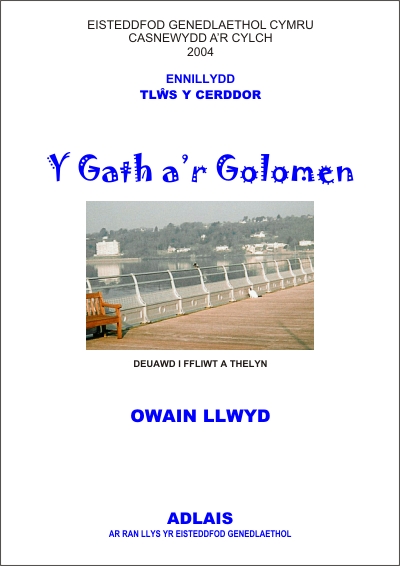
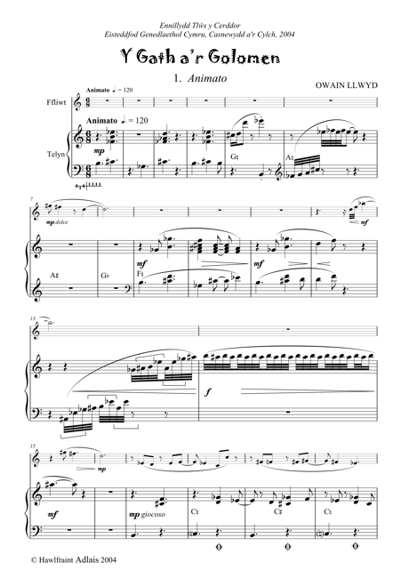
order of the Gorsedd of Bards. Y GATH A'R GOLOMEN Translated from the Welsh, 'Y Gath a'r Golomen' means 'The Cat and the Pigeon’ - two apparently well-known adversaries often seen on the pier in Bangor, and photographed by Owain Llwyd in 2003 (see cover). Inspired by the Eisteddfod requirement of a duo for flute and harp, the composer decided that the harp should portray the cat, and that the flute should portray the pigeon. The underlying tension of the situation is exploited in this brilliant, unusual, dramatic and amusing piece. The first movement, 'Animato', introduces the two characters, the persuasive cat trying to attract the pigeon's attention; but the clever bird escapes the cat's claws, and flies away. 'Portrayal' or 'Characterisation' is perhaps the best translation of the title of the second movement, and the different aspects include 'yn flin' (cross), 'styfnigrwydd' (determination), 'hiwmor' (humour), 'meddyliol' (wistfully) and 'tristwch' (sadness). In the final 'Scherzo', the cat prepares to pounce again, and the piece ends as the bird disappears in a final flurry of feathers… The first performance of 'Y Gath a'r Golomen' was given by Nicola Phillips (Flute) and Deian Siôn Rowlands at the National Eisteddfod of Wales, Newport and District, on Saturday 31 July 2004, immediately following the ceremony during which Owain Llwyd was invested with the Tlws y Cerddor (Composer's Medal). |
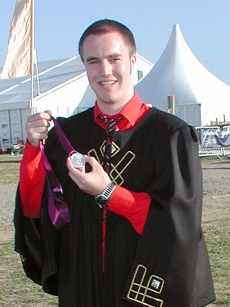 Born in Glyndyfrdwy, near Corwen, in May 1984, Owain Llwyd started
piano lessons at the age of four, and began to compose when he
was eight. After primary education at Ysgol Gynradd Glyndyfrdwy,
and secondary education at Ysgol y Berwyn, Bala, he entered Bangor
University as a music student in 2002.
Born in Glyndyfrdwy, near Corwen, in May 1984, Owain Llwyd started
piano lessons at the age of four, and began to compose when he
was eight. After primary education at Ysgol Gynradd Glyndyfrdwy,
and secondary education at Ysgol y Berwyn, Bala, he entered Bangor
University as a music student in 2002.